Does Sperm DNA Fragmentation Affect Fertility?
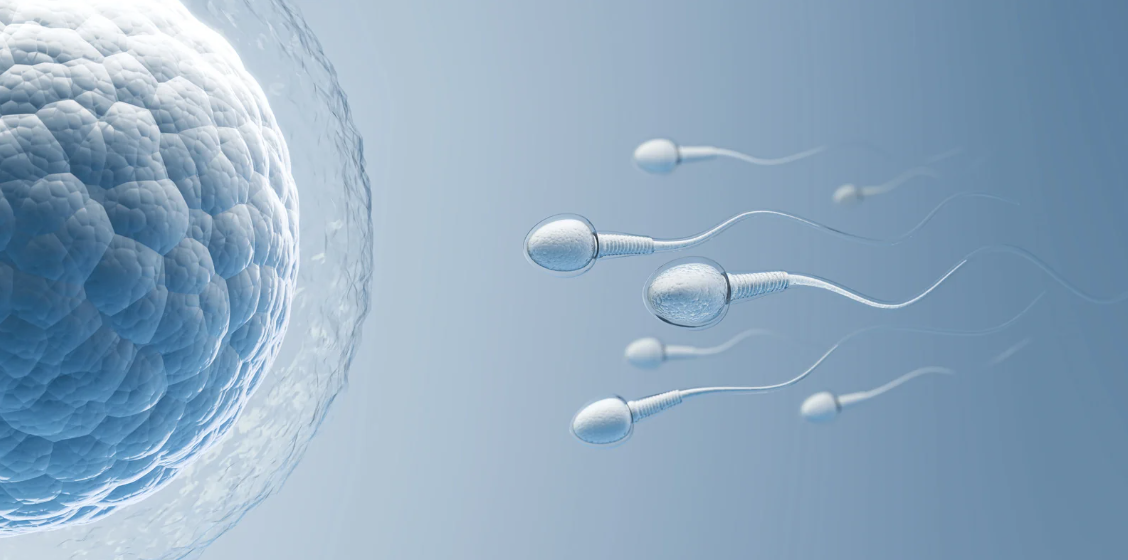
Sperm DNA integrity is an important factor in natural conception and the establishment of a healthy pregnancy. Sperm DNA fragmentation refers to the presence of single or double strand breaks in the DNA strands within the sperm head nucleus. The sperm DNA fragmentation index (DFI), estimates the proportion of spermatozoa carrying fragmented DNA. Nowadays, sperm DNA fragmentation testing is considered a potentially valuable prognostic tool in the assessment of male infertility and reproductive outcomes.
Spermatogenesis
To comprehensively understand the importance of DNA fragmentation it is essential to begin from the fundamentals of semen. Spermatogenesis is the complex biological process through which sperm cells develop and mature, involving both nuclear and morphological changes. It takes place in the seminiferous tubules of the testes and is regulated by hormonal signals, particularly testosterone, which is produced by Leydig cells. Sertoli cells also play a crucial role by supporting and regulating the development of germ cells (Mecklenburg and Hermann, 2016).
Spermatogenesis begins with spermatogonial stem cells, which include type A dark and type A pale spermatogonia. These cells undergo several stages of differentiation, followed by meiotic divisions I and II. Meiosis is one of the most important stages of sperm development because it reduces the chromosome number by half, resulting in haploid cells.
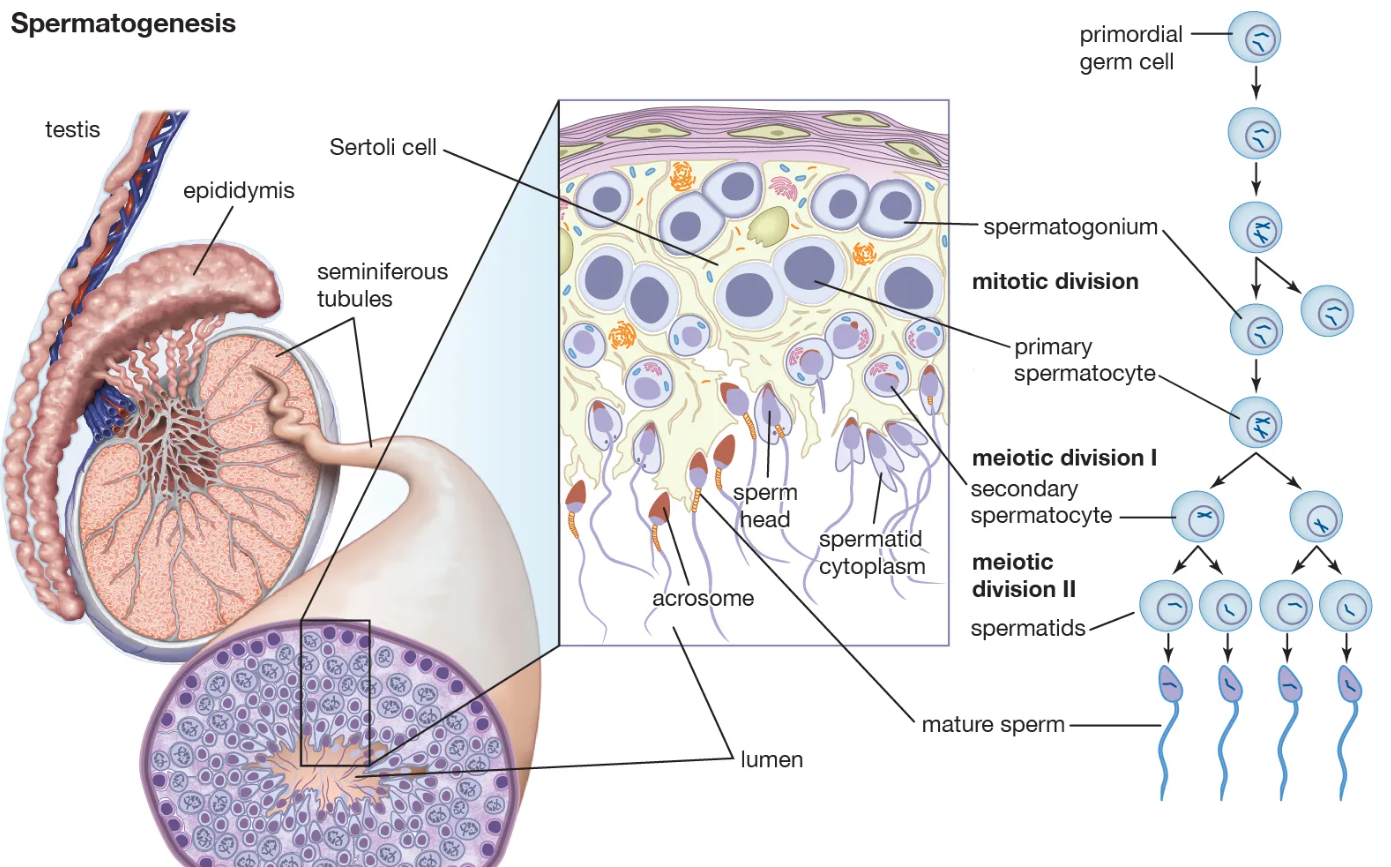
Spermatogonia take land on male reproductive system in testicles. The meiotic division I and II is important to segregate equals from diploid to haploid sperm cells.
During meiosis, homologous chromosomes undergo recombination and subsequently segregate into different filial cells. As a result, each mature spermatozoon contains 23 single chromosomes, which will combine with the 23 chromosomes of the oocyte during conception.
Following spermatogenesis, immature sperm cells undergo spermiogenesis, during which they develop their characteristic morphology. They are subsequently transported to the epididymis, where they undergo further maturation and acquire their functional capacity. The entire process of spermatogenesis takes approximately 72–74 days, excluding epididymal maturation.
DNA Fragmentation and Its Association with Miscarriage
Infertility is defined as the inability to achieve pregnancy after 12 months of regular, unprotected sexual intercourse. It affects approximately 15% of couples of reproductive age worldwide. Despite advances in reproductive medicine, several factors contributing to infertility remain unexplained, potentially affecting the success rates of assisted reproductive technology (ART) (Carson and Kallen, 2021).
DNA strand breaks, involving either single-strand or double-strand damage, may occur due to both endogenous and exogenous factors (Agarwal et al., 2020) .
Endogenous factors include disturbances during sperm maturation, deficiencies in DNA repair mechanisms, abnormalities in the activity of nucleases and topoisomerase II, replication errors, and mitochondrial dysfunction. Furthermore, impaired apoptosis during spermatogenesis may result in the presence of spermatozoa carrying DNA damage in the ejaculate.
Exogenous factors include increased levels of reactive oxygen species (ROS), exposure to ultraviolet radiation, certain medical conditions and treatments, including chemotherapy, environmental and occupational exposures, and advanced paternal age.
Elevated levels of sperm DNA fragmentation, particularly when exceeding certain assay-specific thresholds, have been associated with reduced reproductive potential and an increased risk of adverse pregnancy outcomes, including early pregnancy loss. However, the relationship between sperm DNA fragmentation and miscarriage is influenced by several additional factors.
One possible explanation involves the presence of DNA damage that may compromise the integrity of the paternal genetic material following fertilization. Although the oocyte possesses DNA repair mechanisms that can repair certain types of sperm DNA damage, extensive damage may exceed its repair capacity, potentially affecting embryonic development (Cheng et al., 2026) .
Studies suggest that spontaneous miscarriage cannot be attributed exclusively to elevated sperm DNA fragmentation. Maternal and paternal reproductive age, chromosomal abnormalities, and other genetic and environmental factors may also contribute to pregnancy loss.
Some genetic alterations may arise spontaneously during gametogenesis or early embryonic development. These are known as de novo mutations and are genetic changes that occur for the first time in an individual rather than being inherited from either parent.
Usually the findings upper 30% of total DNA fragmentation in sperms needs futher investigation.
Chromosomal Abnormalities and Genetic Syndromes
Genetic and chromosomal abnormalities may affect embryonic development and, in some cases, lead to pregnancy loss or congenital conditions.
Among the most well-known chromosomal abnormalities are:
- Trisomy 21 (Down syndrome): The presence of an additional copy of chromosome 21.
- Trisomy 18 (Edwards syndrome): A chromosomal condition associated with severe developmental abnormalities.
- Trisomy 13 (Patau syndrome): A chromosomal condition associated with multiple congenital abnormalities.
Other chromosomal conditions include Triple X syndrome (47,XXX) and Klinefelter syndrome (47,XXY), which may affect reproductive function and various aspects of physical development.
It is important to distinguish between chromosomal abnormalities, inherited genetic variants, and de novo mutations. Although genetic alterations may arise spontaneously, sperm DNA fragmentation should not be considered a direct cause of specific chromosomal syndromes. The relationship between sperm DNA integrity, chromosomal abnormalities, and reproductive outcomes requires further investigation (Μιχαήλ Σεβνταλής, 2026).
Genetic Counseling and Fertility Assessment
Our centre provides fertility counseling services, emphasizing the importance of understanding the genetic factors that may influence reproductive health.
Genetic counseling plays an important role in helping prospective parents understand the potential implications of genetic alterations and DNA damage, including their possible effects on reproductive outcomes and future generations.
Through individualized counseling sessions, individuals and couples receive scientific information about the potential benefits, limitations, and implications of available genetic investigations. Adequate counseling allows prospective parents to make informed decisions regarding their reproductive health and family planning (Μιχαήλ Σεβνταλής, 2026).
Understanding sperm DNA integrity is an important step towards a more comprehensive assessment of male reproductive health and fertility.
References
- Agarwal, A., Majzoub, A., Baskaran, S., Panner Selvam, M.K., Cho, C.L., Henkel, R., Finelli, R., Leisegang, K., Sengupta, P., Barbarosie, C., Parekh, N., Alves, M.G., Ko, E., Arafa, M., Tadros, N., Ramasamy, R., Kavoussi, P., Ambar, R., Kuchakulla, M., Robert, K.A., Iovine, C., Durairajanayagam, D., Jindal, S. and Shah, R. (2020). Sperm DNA fragmentation: A new guideline for clinicians. The World Journal of Men’s Health, [online] 38(4), pp.412–471. doi:10.5534/wjmh.200128.
- Carson, S.A. and Kallen, A.N. (2021). Diagnosis and management of infertility: A review. JAMA, [online] 326(1), pp.65–76. doi:10.1001/jama.2021.4788.
- Cheng, S., Yuan, Y., Wang, Z., Xie, Z., Chen, Q., Liu, Z., Chen, Y., Song, T., Yan, M., Zheng, Z. and Lin, H. (2026). Sperm DNA fragmentation and its impact on pregnancy outcomes: A narrative review focusing on threshold definition and clinical strategies. Translational andrology and urology, [online] 15(8), p.304. doi:10.21037/tau-2026-0544.
- Mecklenburg, J.M. and Hermann, B.P. (2016). Mechanisms regulating spermatogonial differentiation. Results and problems in cell differentiation, [online] 58, pp.253–87. doi:10.1007/978-3-319-31973-5_10.
- Μιχαήλ Σεβνταλής (2026). Γιατί η γενετική συμβουλευτική είναι σημαντική πριν τον γενετικό έλεγχο;. [online] Human Genomics. Available at: https://humangenomics.gr/giati-i-genetiki-symvouleftiki-einai-simantiki-prin-ton-genetiko-elegcho/ [Accessed 16 Nov. 2026].
Article by Human Genomics
Michail Sevntalis, BSc, MSc
Genetic Bioscientist